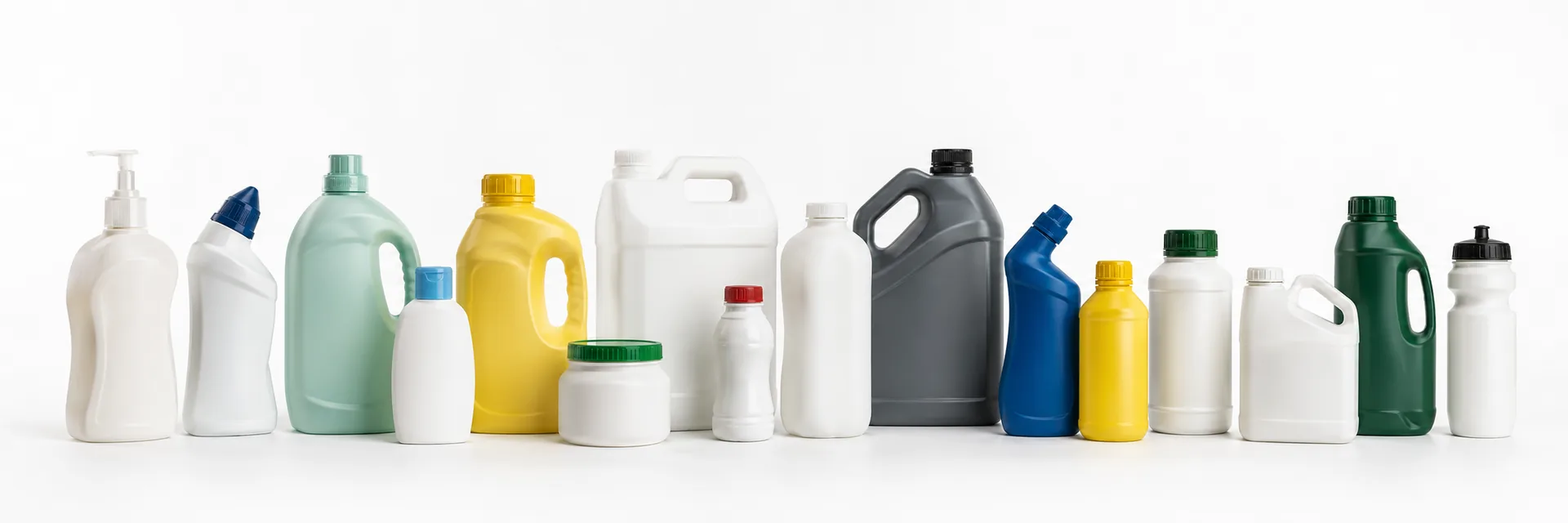
For 2L and 3L laundry detergent bottles, choose the machine after confirming the bottle drawing, target weight, material, handle and neck design, cavity count, required output and downstream inspection. The listed dry cycle alone is not finished-bottle output.
1. Start with the container and its contents
Provide a drawing, a filled-bottle sample where available, and the detergent formulation or relevant packaging requirement before selecting equipment. Nominal volume alone does not determine a machine. The bottle's dimensions, weight, handle geometry, neck finish, labeling area and quality requirements determine the mold and the production process.
HDPE is commonly used for blow-molded detergent and household-chemical containers because grades are available with the stiffness, toughness, chemical resistance and environmental stress-crack resistance required by these applications. The resin grade still has to be approved against the actual detergent formulation and pack-performance requirements by the resin supplier and the bottle producer.
- Specify the target bottle weight and tolerance, not only the 2L or 3L nominal volume.
- State the resin, recycled-content or multilayer requirement, color and additive requirements.
- State whether the bottle needs a handle, special neck, leak test, label process, trimming or traceability.
2. Convert the production target into verified inputs
Confirm the required good bottles per hour, planned operating time, product-change frequency and the downstream process. These inputs are used with the approved bottle, mold concept, cooling conditions and material behavior to determine a feasible configuration.
| Input to confirm | Decision it supports |
|---|---|
| Good-bottle target and planned uptime | Defines the capacity requirement; it is not the same as a dry-cycle figure. |
| Bottle weight, geometry and resin | Informs plasticizing, parison control, cooling and mold review. |
| Mold concept and change frequency | Determines whether flexibility or dedicated production is the priority. |
| Site utilities and downstream equipment | Defines the complete line scope: power, air, cooling, handling and inspection. |
Do not turn a reference dry cycle into a finished-output claim. Confirm the output in a technical proposal or acceptance plan using the approved bottle, resin, mold, cooling and automation scope.
3. Define the line boundary before comparing quotations
A detergent-bottle line can include material handling, mold temperature control, air supply, bottle take-out, flash trimming, regrind handling, leak testing, weighing and conveying. A quotation should clearly identify which of these functions are included, manual or supplied by another party.
Wall-thickness control is a product-specific decision. It should be evaluated from the bottle geometry, weight target and quality requirements, then verified during mold and process development rather than assumed as a universal requirement.
4. Do not choose a model from volume alone
A 2L or 3L detergent bottle may need different machine sizes or layouts when the bottle weight, handle geometry, mold dimensions, required output, resin or automation scope changes. Select the final model only after the approved bottle drawing and production brief have been reviewed together with the mold concept.
5. Verify the proposal before ordering
- Review the bottle drawing, mold layout and utility list with the machine and mold suppliers.
- Set measurable acceptance criteria: bottle weight, visual quality, leakage test method, dimensions and the agreed output basis.
- Confirm how regrind is handled and which percentage is permitted by the finished-pack specification.
- Record the resin grade and detergent compatibility requirements; do not assume that all HDPE grades suit every formulation.
- Agree on trial conditions, sample approval and the definition of a qualified finished bottle.
Common buyer questions
Can one line make both 2L and 3L detergent bottles?
Possibly, but only after the two bottle and mold requirements are reviewed against the proposed machine's limits. The nominal volumes alone are not enough to confirm compatibility.
Does more cavities always mean lower unit cost?
No. More cavities can raise output, but also change mold investment, cooling demand, material distribution, maintenance and changeover complexity. Compare the total production plan, not cavity count in isolation.
How is hourly output confirmed?
Use the approved bottle, resin, mold layout, cooling conditions, quality checks and planned automation to define the output basis. Confirm it in the technical proposal and acceptance criteria.
Technical basis for this guide
This preview intentionally does not name a Tongda model or promise output. Its material guidance is based on published extrusion-blow-molding information from resin manufacturers: Chevron Phillips Chemical: blow-molding resins and LyondellBasell: HDPE for chemical bottles. The final machine recommendation must be based on Tongda's verified technical data and the buyer's approved bottle specification.
Planning a 2L or 3L detergent bottle project?
Send the bottle drawing, target weight and hourly output. Tongda can review the machine, mold and automation configuration together.
Discuss your project →